Description
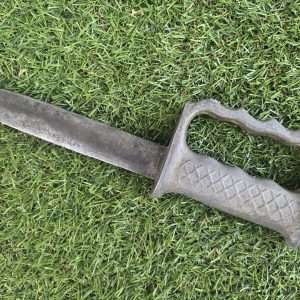
Scottish 93rd Sutherland Highlanders Regiment of Foot Dirk
At a guess about 225 years old around c1800
Maybe this dirk was at the ‘The Thin Red Line’
Condition as pictured
This Scottish infantry regiment was raised in 1799. It served with the British Army until the 1881 reforms, when it was merged into Princess Louise’s (Argyll and Sutherland) Highlanders.
The regiment’s origins lie in the Sutherland Fencibles, home defence troops raised and disbanded three times in northern Scotland during the 18th century.
On the Fencibles’ final disbandment in 1799, its former colonel William Wemyss re-recruited most of its troops into a new regular infantry regiment on behalf of his cousin, Elizabeth, Countess of Sutherland.
This new regiment was given the number 93 in the Army’s order of precedence and formally embodied at Inverness in 1800.
The new unit initially served in the Channel Islands, Scotland and Ireland, before helping capture the Cape of Good Hope from the Dutch in 1806. After eight years in southern Africa, it fought against the Americans at New Orleans in 1815 during the War of 1812 (1812-15). Lengthy garrison duties in Ireland, the West Indies and Canada followed.
In 1813, a 2nd Battalion was raised. This served in Britain and Newfoundland, but was disbanded in 1816.
In 1848, 1st Battalion arrived home for service in Scotland and England. It provided an honour guard for Queen Victoria the following year.
The regiment’s next deployment was to the Crimean War (1854-56) in 1854. It fought with distinction at the Alma (20 September 1854) and became the only infantry unit to win the battle honour Balaklava (25 October 1854), after holding off repeated Russian cavalry charges.
It was for this feat that it gained the nickname ‘The Thin Red Line’, coined by the journalist William Howard Russell. Famous painting
After the Crimea, the regiment was sent to help deal with the Indian Mutiny (1857-59). It won six Victoria Crosses (VC) in one day during the storming of the Secundra Bagh in Lucknow in November 1857.
A seventh VC was won by William Bean, a lieutenant in the regiment, for killing 11 rebels at the gate of Kaiser Bagh. The following month, it fought at the capture of Cawnpore.
The regiment then remained in India on garrison duty until 1870, taking part in the Umbeyla Campaign (1863-64).